
Your street has already decided what your home can be worth. You don’t get a vote on it. And neither does your budget.
In fact, you can spend $200,000.00, $300,000.00, or more. And if the finished home sits above what your area actually pays for a home like it, the market won’t hand that money back to you. Not when you refinance. Not when you sell. It’s simply gone, poured into a house that looks beautiful and will never return what you put into it.
I’ve watched people do exactly this. They spend the money, they get the home, and years later they find out the hard way that the renovation was never going to add up. By then there’s nothing to be done about it.
There’s a name for that mistake: Overcapitalising. Spending more on a home than the home, in its location, will ever be worth. It’s the most common, the most expensive, and the most invisible error I see homeowners make, because nothing on site ever looks like it’s going wrong.
This matters especially in established parts of the St George area, Kogarah, Georges River and Bayside, where two homes only a few streets apart can sit in very different value bands. A renovation that makes financial sense in Oatley or Blakehurst may not stack up the same way in Carlton, Bexley, Hurstville, Sans Souci or Ramsgate. And once you start looking slightly further afield, into parts of the Inner West south, Canterbury-Bankstown or northern Sutherland Shire, the numbers can shift again.
In Reality, Your Budget Was Never the Right Ceiling
Most people work this out backwards.
They start with the number they can spend, hand it to a designer, and let the plans grow to fill it. The budget becomes the ceiling. But the budget was never the ceiling that mattered. The market is.
Return on a renovation or a rebuild comes down to one thing: the market value of homes in and around your area. That means understanding what buyers are actually paying for homes like yours in your suburb, your street, and the nearby pockets people compare it against. In St George, that can change quickly between Kogarah, Hurstville, Oatley, Bexley, Sans Souci, Blakehurst and Ramsgate. That’s the real indicator, and it’s the one almost nobody runs before they commit.
Sure, you can control what you spend. What you can’t control, on the other hand, is what your street is worth. So the question isn’t “how much can I afford to put in,” it’s “how much will this area ever give me back.”
If you don’t know that second number, all you’re doing is guessing with the biggest asset you own.
The Budget Trap That Closes Behind You
There’s a second trap waiting inside the budget itself.
A knockdown rebuild will usually run around 30-40% more than a renovation. So when money is tight, the decision quietly falls into the renovation bucket. Not because renovating is the smarter financial move, but because it’s the only one that fits. That’s fine if you’ve run the maths and you know the area will reward it, but it’s a slow disaster if you haven’t.
And it only gets worse when you hold your real budget back from your builder thinking they’ll spend all of it. The problem is that a designer briefed without a ceiling draws to the vision, not the wallet. By the time those plans reach a builder for pricing, the gap between what was imagined and what’s affordable is already baked into the documentation. It’s a Mercedes finish on a small car budget, and closing that gap means paying again to redo work you’ve already paid for once.
Renovation budgets rarely break in one big jump, either. A wall comes down and the plumbing needs relocating. The waterproofing opens up something nobody quoted. Each variation feels manageable in the moment, each one gets approved because stopping feels worse, and twelve months into a job quoted at $200,000.00, you’re standing at $400,000.00 and beyond.
Still in a structure that was never going to return the difference.
What Running the Maths Actually Looks Like
My wife and I bought a two bedroom place in Kogarah for around $800,000.00, and we’ve been there fourteen years. In that time, the local market has moved underneath us. What a four bedroom home nearby is worth today varies enormously, depending on the land size, the location, the size of the home and the quality of the finish.
And that variation is exactly the point. Whether turning our place into a four bedroom would come out ahead of simply buying a finished one in the same street depends entirely on where that finished home sits in the range. Run the numbers one way and the renovation makes sense, with the market underneath it ready to catch the money. Run them the other way, and you’d seriously have to question why you’d spend more creating a home than it would cost to buy one nearby.
The numbers don’t sit still, either. The honest answer moves with the market, and the only way to know which side of the line you’re standing on is to crunch the numbers before you fall in love with a set of plans.
That’s why this calculation has to be local. A renovation in Bayside or Georges River can’t be judged by a broad Sydney average. And it shouldn’t be judged against what someone spent ten kilometres away either. The only numbers that matter are the homes your future buyer will compare you against.
Bottom Line: Start With the Numbers First
This is the most significant financial decision most families ever make, and the cruelty of getting it wrong is that it stays hidden.
There’s no moment on site where you can see it happening. The build can be flawless. The home can be everything you pictured. The mistake only surfaces later, quietly, the day you go to refinance or sell and the number coming back is lower than the number you put in. That’s not a feeling you can renovate your way out of. It’s locked in.
So the most expensive mistake in building was never the builder you chose or the tiles you picked. It was committing your money to a direction before anyone checked whether the maths was ever going to work. Get that part right and everything after it is just execution. Get it wrong and every dollar you spend is chasing a return that was never there to begin with.
If you’re weighing up a renovation or a rebuild right now, don’t start with the drawings. Start with the numbers.
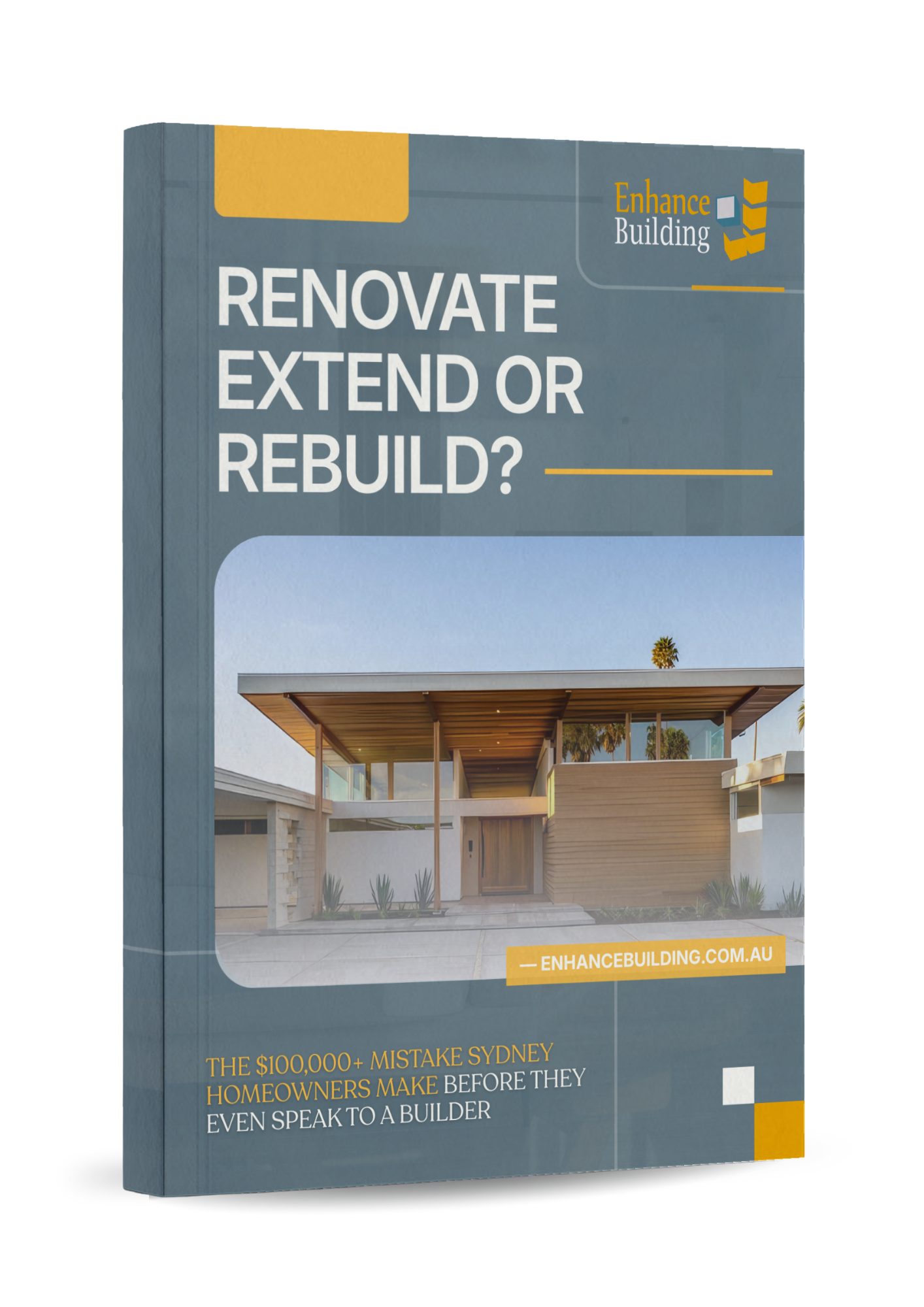
I’ve put together a free guide to help you work it through properly before you commit a dollar:
Inside, you’ll discover:
- Why the path you choose decides your return long before the finishes ever do
- The crossover point where a renovation quietly costs more than a rebuild
- Why protecting your budget from your builder almost always costs you more
- How to read what your suburb and surrounding market are genuinely worth before you overcapitalise
- The questions worth asking any builder before you sign anything
Download your copy now, before you spend money creating a home the market was never going to pay you back for.
Frequently asked questions
What does it mean to overcapitalise on a renovation?
Overcapitalising means spending more on a home than it will ever be worth in its location. You can pour $200,000 or more into a beautiful renovation, but if the finished home sits above what your street actually pays, the market never hands that money back, whether you refinance or sell. It is the most common and most invisible renovation mistake.
Is it cheaper to renovate or knock down and rebuild?
A knockdown rebuild usually runs around 30 to 40 percent more than a renovation, so when budgets are tight the decision often defaults to renovating. That is only the right call if the numbers in your suburb reward it. The smarter first step is to weigh renovating against rebuilding or moving before you commit.
How do I know if a renovation is worth it in my suburb?
Compare what buyers actually pay for finished homes like yours in your street and nearby pockets, then work backwards. In the St George area, values shift quickly between Kogarah, Oatley, Bexley and Hurstville. Running the full renovation costs against that local market value is the only reliable test.
Why does my street’s value matter more than my budget?
You control what you spend, but you cannot control what your street is worth. Return on a renovation comes down to the market value of homes around you, not the size of your budget. If the finished home sits above the ceiling your area will pay, the extra spend is gone. The market sets the ceiling, not your wallet.
How can I avoid overcapitalising before I start?
Start with the numbers, not the drawings. Crunch your local market values and the realistic return before you fall in love with a set of plans, and be upfront with your builder about your real budget. Government resources such as MoneySmart help with the finances, and Enhance Building helps St George homeowners run this maths first.
Thinking about a renovation or rebuild in the St George area? Run the numbers with Erwin before you commit to plans. Contact Enhance Building or call 0468 057 127.
Related Articles
Still have questions? See our full renovations and extensions FAQ.