

The quotes come back on a Tuesday afternoon.
You budgeted $40K for the bathroom. You felt pretty confident about the number because a mate had one done for around that, and the renovation shows always make the whole thing look fairly straightforward.
But the first quote says $70,000.00. The second says $80,000.00. The third says $90,000.00.
You read them again, certain someone’s made a mistake.
Only, nobody has.
Now you’re already thousands of dollars in. The design’s drawn, paid for, and wrong. Changing it means paying again. Keeping it means finding money you don’t have.
I’ve watched this exact moment play out for homeowners across the St George area more times than I can count. And it almost never starts with a bad builder or a bad designer.
It starts much earlier, with a concept someone fell in love with before anyone sat down and worked out what it would actually cost to build.
That’s where the real problem begins. Because by the time the quotes arrive, you’re no longer making a purely financial decision.
The Home You’ve Already Moved Into
(That Doesn’t Exist Yet)
This is the part nobody really warns you about.
By the time your plans are drawn, you’ve already moved in emotionally.
You’ve pictured the family gathering in that kitchen. You’ve imagined the barbecues in the outdoor area. You’ve mentally hosted the first Christmas, worked out where the couch will go, and maybe even pictured yourself growing older in the home.
It feels real because, in your mind, it already is.
The problem is that the home’s real in every way except the one that matters most: whether your money can actually build it.
The trouble is, early cost expectations are often built on comparisons that look relevant but aren’t.
An online cost guide gives you a broad average. A price from another project gets repeated without the site, structure, access, or level of finish that produced it. A number from two years ago is treated as though nothing has changed. And a designer creates something beautiful, but they may not price buildings every day because that’s not their job.
So the plans grow to fit the dream.
Then they go out to tender, and the market tells you the truth all at once.
Fifteen, twenty, or thirty thousand dollars into the design work, you discover that the home your family’s been living in for months, at least in your imagination, was never affordable in the first place.
Now you’ve got to unwind it.
You’re telling your partner the kitchen has to shrink. You’re telling the kids the rumpus room is gone. You’re paying the designer again to draw a smaller version of something you already felt belonged to you.
And that’s why redesign can feel so much heavier than changing a few lines on a plan.
A $1 Million Budget. A $2.5 Million Build Price.
I had a lady in Marrickville come to me after doing exactly this.
She’d gone away and designed a beautiful six-bedroom home with a full outdoor barbecue area, generous spaces, and lovely specifications. It was a genuinely impressive set of plans.
Her budget was $1 million.
Once the size, specifications, and construction requirements were properly costed, the realistic build price was approximately $2.5 million.
By the time we had that conversation, she’d spent close to $120,000.00 developing the design.
That’s real money spent on a home that was never going to be built in that form. And it wasn’t because anyone had done poor work. The plans were lovely. The designers had done what they were engaged to do.
But nobody had stood beside her early enough and connected the drawings to the dollars.
That’s the part homeowners often miss.
A design can be beautiful, thoughtful, and technically sound, but still be completely wrong for the budget.
And when you discover that disconnect late, the cost isn’t only the original design fee. It’s the redesign, the delay, the emotional disappointment. And it’s the loss of momentum that comes with feeling like you’re suddenly going backwards.
The Marrickville case was extreme. But I regularly meet homeowners who are already $15,000, $20,000, or $30,000 into design work before discovering that the project has grown beyond what they can afford to build.
On a major renovation or knockdown rebuild, the combined cost of abandoned design work, redesign, and delay can quietly reach tens of thousands of dollars before a single trade sets foot on site.
And the scary part is, the damage happens while everything still feels exciting.
That’s what makes it so dangerous.
The Numbers-First Rule:
How to Design to Your Budget Instead of Past It
The fix isn’t overly complicated, but it does mean changing the order most people approach the project in.
The Numbers-First Rule is simple: establish what the entire project is allowed to cost, put someone who prices buildings beside the person designing yours, and let the plans develop inside that financial boundary, not outside it.
That’s how you give the dream the best chance of surviving contact with reality.
There are three things that make the biggest difference:
1. Have The Budget Conversation Before The Drawings Start
I know this can feel uncomfortable.
Most people don’t want to reveal their full number because they’re worried it’ll all get spent. They think that if they say they’ve got $200K – $400K, every dollar will somehow disappear into the project. But if a designer doesn’t know the real budget, they can only design to the vision. They can’t design to financial boundaries they haven’t been given.
And that gap is what you pay for later.
One important distinction is that your total project budget isn’t necessarily the same as your construction budget.
Depending on the project, the total amount may also need to cover design and consultant fees, approvals, investigations, temporary accommodation, landscaping, selections outside the building contract, and an appropriate contingency.
The exact allowances will vary. But they need to be identified before the drawings are allowed to grow.
What remains is the figure the developing design must be tested against.
When the number’s on the table from day one, every line drawn has a reason to exist. Every room, finish, and feature can be looked at in relation to the project as a whole. Instead of finding out at tender that the home’s grown beyond reach, you make smaller, cheaper adjustments while the design’s still flexible.
You’re not giving up control by doing it this way. In fact, it’s precisely how you keep control before the project becomes too financially and emotionally expensive to unwind.
2. Put Someone Who Prices Buildings Beside The Person Designing Yours
A builder who regularly completes these kinds of renovations, or a quantity surveyor, can usually keep the project much closer to the real construction cost as the concept develops.
You might still be ten or twenty per cent either way because renovation pricing isn’t an exact science. But you’ll be a lot closer than you would be if nobody involved is pricing this kind of work day in and day out.
That’s the difference between adjusting the size of a room on paper and redesigning an entire home after tender.
Designers are exceptional at creating spaces, solving layouts, and bringing ideas to life. Costing what they draw is a different skill, especially with renovation work where the site, structure, access, age of the home, and hidden conditions all affect the number.
You need both skills in the room.
When the builder or quantity surveyor is involved early, the design can respond to the budget as it develops. If one decision pushes the cost too far, you can correct it before the rest of the home gets built around it.
The earlier that correction happens, the cheaper and less painful it’ll be.
3. Design To The Number, Not Around It
This is where a lot of homeowners feel as though they’re being asked to settle, but the opposite is actually true.
Designing to the number doesn’t mean giving up on a beautiful home. It means deciding where the money matters most, where it’ll improve daily life, and where a simpler solution can achieve almost the same result without putting the whole project at risk.
A home you can actually finish will always serve you better than a more impressive home that only exists on paper.
You don’t need to reduce the dream until there’s nothing left. Instead, the goal should be to shape the dream into something your budget can carry all the way through to completion. That’s how you end up with a home your family actually gets to live in, instead of a beautiful set of plans sitting in a drawer.
The Most Expensive Room Is the One That Only Ever Existed on Paper
Every dollar spent designing a home your budget can’t build is a dollar that comes out of the home it can.
That’s the real cost of falling in love too early.
It’s not just the first round of design fees, but also the redesign fees that follow. It’s not just the money, but also the months spent going backwards. And it’s not just the months, either. It’s the quiet deflation of walking your family back from a home they’d already imagined living in.
That emotional cost matters because once people become attached to a concept, every practical adjustment starts to feel like a loss.
And that’s why the order matters so much.
Whether you’re renovating a Federation home in Bexley, extending in Oatley, or weighing up a knockdown rebuild in Sans Souci, the sequence can decide the outcome.
Numbers first. Then drawings. Then a home you can actually build, finish, and live in.
The best renovations don’t start with a concept someone hopes the budget will somehow stretch to accommodate. They start with an honest conversation about what that concept is allowed to cost.
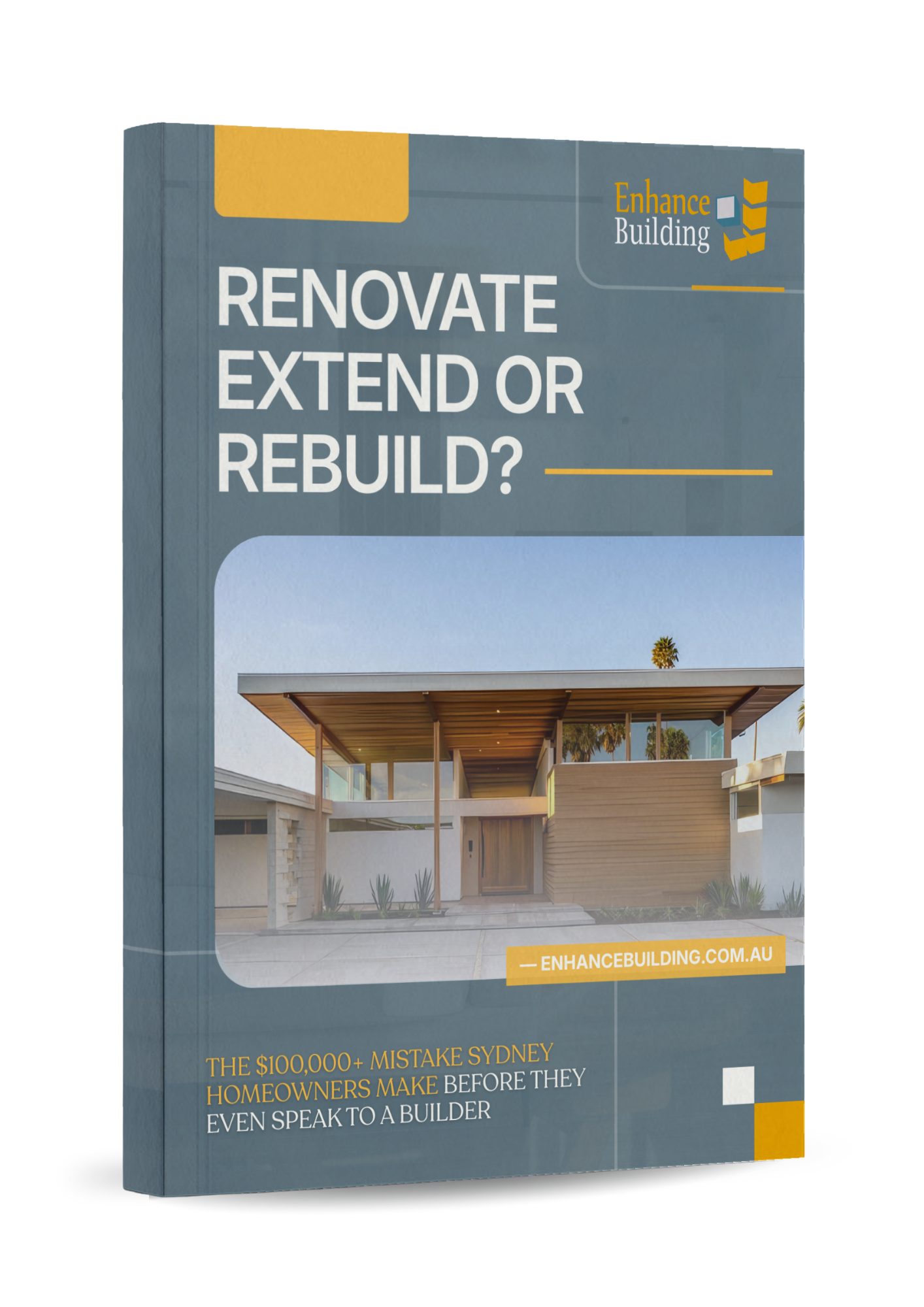
Before you spend thousands committing to plans, you first need to know which path – renovating, extending, or rebuilding – gives your budget the best chance of producing the home your family actually needs.
And that’s exactly why I put together this free guide:
Inside, you’ll discover:
- The early budgeting mistake that can make an otherwise excellent design impossible to build
- Why so many renovation plans never make it beyond the drawing stage
- What homeowners most often underestimate about timelines and living through construction
- The questions to answer before detailed design locks you into the wrong path
- How to compare renovating, extending, and rebuilding before design fees and emotional attachment narrow your options
Download your copy now, before you fall in love with a set of plans your budget was never going to build.
Because the home worth falling in love with isn’t the one that looks best on paper. It’s the one you can actually afford to finish, move into, and make your own.
Frequently Asked Questions
How do I work out what my renovation will actually cost before I pay for a design?
Get a builder or quantity surveyor involved alongside your designer from the very beginning. Someone who prices buildings week in and week out can keep the concept much closer to current market cost as it develops, instead of leaving you to discover the real number at tender. The earlier that expertise enters the process, the cheaper and easier every course correction becomes.
Should I tell my builder my real budget, or hold some back?
Tell them the real number. Holding it back can feel safer, but it often produces plans that outgrow your money, and redesigning means paying twice. A good builder uses your budget to help you get the best possible home for it, not to spend money simply because it’s available. The conversation’s uncomfortable for most people, which is why the right builder will have a clear process to make it practical rather than awkward.
Why did my renovation quotes come back so much higher than I expected?
Usually, it’s because the expectation was shaped by hearsay: a friend’s project, a television renovation, or an old price that no longer reflects the market. Custom renovation work also carries site-specific risks that standard project home pricing doesn’t, and those costs have to sit somewhere. If every quote comes back well above your number, the quotes probably aren’t the problem. The design was developed without enough connection to what it would really cost to build.
Is it worth paying for design work before I’ve decided between renovating and rebuilding?
Avoid commissioning detailed design until you’ve compared the feasibility and likely cost of renovating, extending, and rebuilding. Some early concept or feasibility work may be necessary to compare the options intelligently. But its purpose should be to help you choose the right path, not to lock you into one before the numbers have been tested. Work through the options first. Then develop the detailed design within the path that makes sense for your home, council area, and budget, whether that’s in Georges River, Bayside, or the surrounding St George area.
Before you commit to detailed plans, compare the three paths and give your budget a chance to shape the decision.
Get the free guide before you pay for plans
Planning a renovation in the St George area and want the numbers to work before the plans are drawn? Talk it through with Erwin at Enhance Building. Contact Enhance Building or call 0468 057 127.